Before the Hello: Reading a Residential Street Through Its Door Furniture
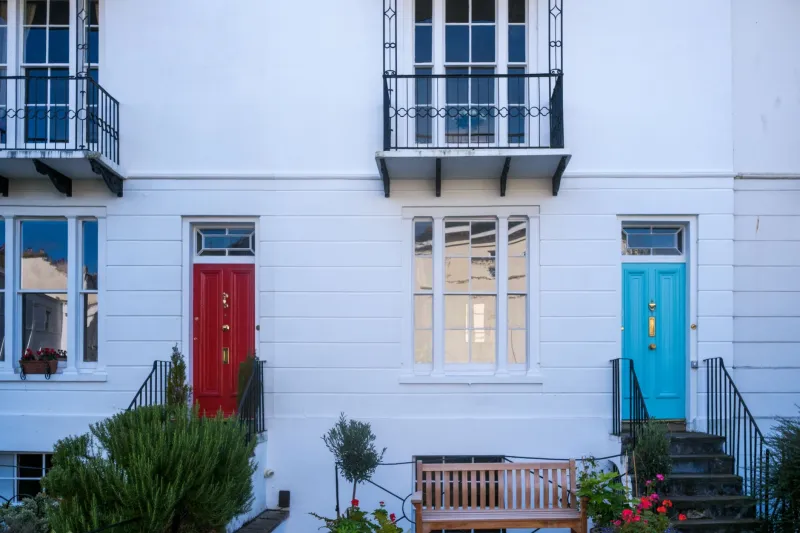
A Street as a Specimen
The first thing a visitor touches at a house is rarely the door. It is the gate latch, the step, the bell push, the knocker, the handle. These small fittings form the opening sequence of arrival: a series of permissions negotiated at close range, in public, before a word is spoken. Door furniture is the greeting before speech.
I chose a single residential road of about ninety houses, mixed in age and tenure, and walked it twice — once on a dry morning, once in steady rain. I recorded material, finish, height, wear, sound and the small improvisations that residents make when the original object fails. I have not named the road. The point is not the location but the method: to read a street as a sequence of interfaces.
Era in the Metal
The first reading is chronological. Victorian terraces tend to keep four-panel doors, brass centre knobs, heavy letterboxes with flaps and cast-iron knockers. Edwardian houses often show lighter glazing and slimmer brass. The 1930s semi-detached house announces itself with stained glass, chrome and early plastics; the post-war decades with aluminium, then uPVC. Recent work favours long bar handles, brushed steel and the video doorbell.
But era is only the first reading. Maintenance, weather and fashion rewrite the metal. A Victorian door may carry a modern cylinder lock and a wireless bell. A 1930s door may have lost its original knocker to a previous owner and gained a plastic number plaque. The street is not a museum; it is a working set of compromises.
The Four Interfaces
The Handle
The handle is the most handled object at the house and the least discussed. A knob demands grip; a lever accepts a palm, a wrist, occasionally an elbow. Height matters more than style: most sit between waist and chest, but the exceptions reveal the age of the door and the reach of the household. Brass is cold in winter and darkens where hands rest. A lever with a sharp return is a small act of hostility. A handle should feel like the door it opens; a light handle on a heavy door is a lie about weight.
The Knocker
The knocker is sound as signature. Cast iron, brass, a lion, a hand, a simple loop. It asks the visitor to make a decision: how hard, how many times, how long to wait. It is a public performance. Where a knocker is absent, the letterbox flap often becomes the knocker, which is a different social act entirely — louder, more urgent, less formal.
The Letterbox
The letterbox is a controlled aperture. Its spring tension is a small engineering problem: too stiff and the post is damaged; too loose and the flap rattles in the draught. The internal brush or hood is a courtesy to the hallway. The clack of the flap is the house’s smallest announcement, and the position of the box — centre rail, below the lock, occasionally low in the door — changes how the street physically enters the home.
The Bell
The bell push has the shortest feedback loop and the greatest anxiety. A chime, a click, a buzz, or nothing at all. The wireless bell added a second device; the video bell added a camera and a delay. The etiquette of the camera is unresolved: who is watching whom, and what is owed to a visitor who cannot see the person who answers. A bell is a request, not a demand, but the technology rarely makes that distinction.
The Etiquette of Arrival
The British threshold has a grammar. Stand back after ringing. Do not peer through the glass. A second ring is impatience; a single knock and a step back is confidence. The printed sign — ‘please knock’, ‘bell not working’, ‘no cold callers’ — is typography at thirty millimetres, doing the work of a receptionist. The broken bell is a small social failure, repaired eventually or lived with for years.
The door furniture also sets the distance between private and public. A letterbox admits paper but not a hand. A knocker announces a body. A camera admits a face before the door does. Each object draws the boundary differently, and the street reads those boundaries without much conscious thought.
Process Notes
- Design for the hand in winter. Thermal conductivity, texture and grip matter more than a showroom finish. Brass and steel are not neutral in January.
- Let weight tell the truth. The resistance of a handle or the spring of a letterbox flap should correspond to the door and the weather, not to a catalogue photograph.
- Treat sound as feedback. The click of a latch, the clack of a flap and the chime of a bell are confirmations. Silence is a design decision, and usually a poor one.
- Design for the aged state. Rain tracks, verdigris, rust and UV fading are not failures; they are the object’s future. A finish that only looks correct on day one is a short contract.
- Plan for maintenance. The loose knob is usually an installation failure, not an object failure. Screws, backplates and alignment are part of the interface.
- Respect tolerance. Cold fingers, gloves, parcels, draughts and letterbox springs all test the same few millimetres.
- Keep signage modest and legible. A faded ‘Ring’ is still a piece of public typography.
- Test accessibility at the door first. Lever handles, contrast, reach and force are not add-ons; they are the first test of whether a house is welcoming.
A Modest Conclusion
The street has been teaching affordances for centuries in brass and iron. The handle, knocker, letterbox and bell are a sequence of permissions, and to design them well is to understand that arrival is a negotiation conducted at close range, in all weathers. The next time I specify a handle, I will think of the road: ninety doorways, each one a different answer to the same question — how does a house say hello?