The Accidental Archive: A Year of Second-Hand Design References
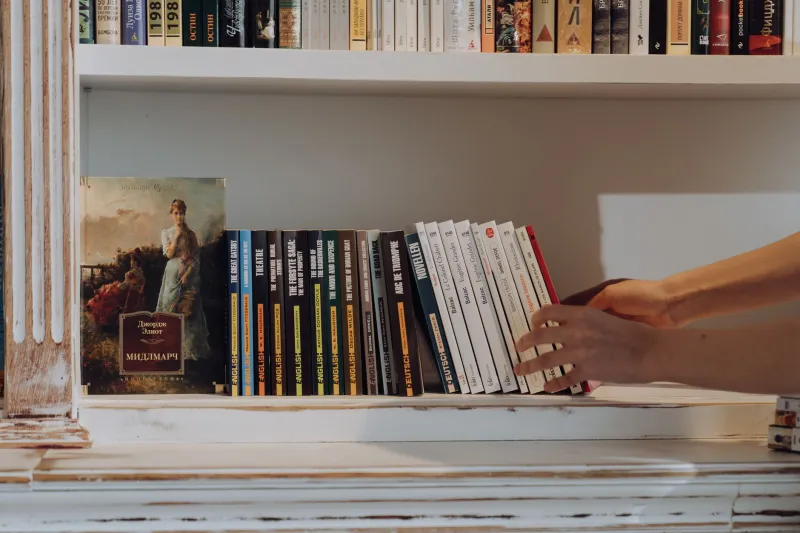
The Shelf as a Record of Chance
There is a particular kind of shelf that forms without a plan. It begins with a single paperback found on a rainy Saturday in a charity shop in, say, Lewisham or Leith, and ends, twelve months later, as a small, uneven library of references that no search field could have predicted. My own shelf now holds a 1972 Letraset catalogue, a 1968 Observer’s Book of British Wild Flowers, a battered copy of a 1980s British Rail timetable, three Ladybird books on subjects I have never needed to know, and a monograph on a mid-century British illustrator whose name I had not encountered before. None of these were commissioned. None were recommended by a feed. They arrived by accident, and that is precisely their value.
The design conversation of the past decade has been dominated by the logic of the feed: the algorithmic recommendation, the saved post, the infinite scroll of references that look like everything else. I do not wish to be ungrateful for the access. But access is not the same as influence. Influence, in the studio sense, is what actually changes the way you see and make. And the charity shop, with its random assortment of discarded books, offers a different kind of education: one built on proximity, cost and chance rather than relevance and recency.
What Twelve Months Yielded
Over the past year I have kept a simple note of each find: the title, the date, the price, the shop, and one sentence on why I brought it home. The notes are not a catalogue of good taste. They are a record of curiosity. A 1974 Letraset catalogue, for instance, was bought for 50p in a shop in Bristol. I have no use for dry transfer lettering, but the catalogue’s pages of condensed sans-serifs and geometric display faces have become a reference for a current identity project. The 1980s British Rail timetable, found in a shop in Carlisle, is a lesson in the poetry of tabular data: its columns, rules and dense hierarchy are more instructive than many a contemporary information design manual.
The Ladybird books are perhaps the most surprising. Their illustrations, commissioned from jobbing artists rather than celebrities, have a consistency of tone and a restraint of palette that I find increasingly useful. They were made to be cheap, legible and reproducible. That is not a bad brief for any designer. The monographs, by contrast, are often the most conventional finds: a survey of a graphic designer’s work, a history of a movement. They are useful, but they are also the closest thing on the shelf to the algorithmic feed. They were made to be admired. The annuals and catalogues were made to be used.
What has changed in my own work is not a sudden shift in style. It is a shift in attention. I notice more often the way a bus ticket lays out its information, the spacing on a parish newsletter, the colour of a chip shop menu board. The shelf has taught me to treat the ordinary printed world as a legitimate source of design ideas. That is not a novel observation, but it is one that is easily forgotten when your references arrive pre-curated.
The Audit: Separating Influence from Input
If you want to understand your own influences, a simple audit can help. Set aside an hour. List every reference you have consciously used in the past three months: websites, books, images, exhibitions. Then mark each one with a letter: A for algorithmic (found through a feed, a recommendation or a search), P for purchased or borrowed deliberately, and C for chance (found in a charity shop, a jumble sale, a discarded pile). Most designers will find that A dominates. That is not a moral failure; it is a structural fact of contemporary practice. But the audit makes the imbalance visible.
Next, look at the C references. What do they have in common? Are they mostly typographic, photographic, illustrative? Do they share a period, a format, a tone? The point is not to force a theme but to notice one. In my own audit, the C references clustered around mid-century British instructional design: catalogues, timetables, manuals, annuals. That cluster has become a quiet through-line in my work, even when I am not conscious of it.
Finally, ask a harder question: which of these references have actually changed a decision you made? Not which you found interesting, but which altered a layout, a colour choice, a piece of copy. Influence is not the same as inspiration. Influence leaves a mark on the work. The charity shop finds have left more marks than I expected, largely because they arrived without a ready-made interpretation. I had to work out what they meant.
An Exercise: The Local Brief
Here is a short exercise for turning overlooked local material into a project brief. Choose three items from your immediate surroundings that were not made with design in mind. A parish newsletter, a bus timetable, a takeaway menu, a council leaflet, a seed packet. Spend thirty minutes with each, noting how it organises information, what it assumes about its reader, and what it does well despite its lack of polish. Then write a one-page brief for a new piece of work that borrows one structural or tonal lesson from each item. The brief should be specific enough to make something, but not so specific that it becomes a pastiche.
The exercise is deliberately modest. It is not a substitute for proper research or a client brief. But it is a way of keeping the eye sharp, and of reminding yourself that influence can come from anywhere, not only from the places you have been trained to look.
A Note on Restraint
The charity shop shelf is not a solution to the problem of reference overload. It is a small, local practice. It costs very little. It requires no subscription. It rewards patience and a willingness to look at things that are not immediately useful. In a culture that prizes the new, the fast and the tailored, there is something quietly useful about a shelf that is none of those things. It is an accidental archive, and it is the better for it.