The Kettle as Colleague: A Process Journal of Mugs, Biscuits and Interruption
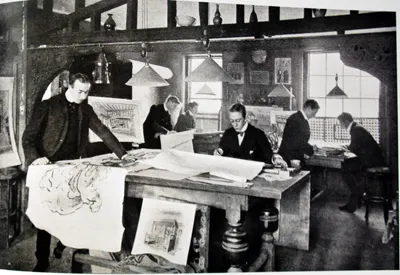
Photo: Unknown authorUnknown author, Public domain, via Wikimedia Commons
At a certain point in the afternoon, the studio stops pretending to be a single mind. Someone stands, asks who wants tea, and the room rearranges itself around a question. This is not a break from design. It is one of the ways design gets done. The tea round is a small, repeating protocol: a check on who is present, who is under pressure, who has been quiet for too long. In a UK studio, it arrives with its own grammar — the mug, the milk, the biscuit tin, the brief pause before someone says yes. To treat it as mere administration is to miss a useful record of how work actually moves.
The Interval That Carries the Work
Interruption has a poor reputation in design writing. It is usually set against focus, as though concentration were the only legitimate state of a studio. In practice, the tea round is a controlled interruption: short, familiar and socially legible. It gives a stalled conversation somewhere to go. It allows a half-formed thought to be tested without the formality of a review. It creates enough distance for a decision to settle, or for a bad one to be noticed.
I have come to think of the round as a low-stakes review. Nothing is minuted, yet a great deal is exchanged. A designer may mention that a layout still feels tight; a project manager may admit that a client has gone quiet; someone may remember a constraint that had slipped from the brief. These are not trivial asides. They are the small corrections from which a project is built. A project-management template can record tasks and deadlines, but it struggles to record the moment when a room quietly agrees that a direction is wrong.
The Honest Chipped Mug
Studio mugs are not neutral objects. They accumulate ownership, preference and wear. One is reserved for strong coffee; another has a chip on the rim that its owner refuses to replace; a third has been borrowed so often that its original home is no longer clear. This is not quaint detail. It is evidence of use. A chipped mug says that a studio is a place where things are handled, not merely displayed.
That matters in a discipline increasingly drawn to polished surfaces. Portfolios show finished work; case studies show cleaned-up decisions; social media shows the studio at its most composed. The chipped mug is a useful corrective. It reminds us that design is made by people with habits, preferences and limited patience. When I record a process note, I try to notice these conditions without romanticising them. The point is not to publish a photograph of the mug. The point is to remember that the work was made in a room, by people, under a particular kind of pressure.
A Sticky Note as a Design Document
The sticky note left on a monitor is another under-read artefact. It might say “check bleed”, “ask about print budget” or simply “no”. Its wording is often compressed to the point of rudeness, but its position is precise. It is placed where the next person will see it. It is a temporary instruction, a fragment of correspondence and a small act of care. It also has a lifespan. Some notes survive for weeks; others are removed within minutes because the problem has been solved.
I have started noting the sticky notes that change an action. Not every one — that would be hoarding — but those that carry a decision. A note reading “client wants warmer grey” is not much on its own. A note reading “client wants warmer grey — test against paper stock” records a constraint and a next step. The difference is the difference between a reminder and a design document. The studio’s process journal should capture the latter.
Biscuit-Tin Consensus
The shared biscuit tin is a small exercise in negotiation. Who opens it, who takes the last one, whether the tin is passed without comment or with an apology: these are not matters of great consequence, but they reveal how a studio accommodates people. Consensus in design is rarely produced by a single meeting. It is produced by repeated small adjustments — a preference remembered, a deadline shifted, a criticism softened, a credit shared.
In a process journal, these moments can be recorded as “consensus notes”: who was present, what changed, what remained unresolved. The record should be brief. A sentence is usually enough. The aim is not to document every biscuit, but to notice where a decision actually settled. Often it settles at the edge of the official conversation, when someone says, almost in passing, that the type looks better slightly smaller. That remark may be the most useful design critique of the day.
Keeping a Ritual Log
A ritual log does not need software. A single page per week is sufficient. I use four columns: ritual, people, trigger and effect. Under “ritual” I might write “afternoon tea round”; under “trigger”, “proof awaiting client”; under “effect”, “print budget raised; stock sample requested”. The entries are deliberately short. They are prompts for memory, not transcripts.
There are ethical limits. A studio ritual log should not become a surveillance tool. It should record decisions and conditions, not personal disclosures. Consent matters, especially in a small team. If the log is shared, names can be reduced to roles. The purpose is to understand how work is made, not to evaluate who drank what. Reviewed monthly, the log can be linked to project phases and used in post-project reviews. It can also feed the studio’s portfolio writing, giving process notes a specificity that generic case studies lack.
What the Kettle Teaches
The kettle does not produce design. It produces conditions in which design can be discussed. The studio that records those conditions can explain its decisions more honestly than one that archives only final files. A portfolio shows outputs; a process journal shows the weather in which they were made. The tea round is not a method to optimise. It is a method to notice. The mug is chipped, the note is curling, and the work is still moving.